By Sophia Harris / Columnist
I recently had the privilege of getting my colors analyzed to find my color season. This was a fun and encouraging experience that has taken the way I see color in an entirely different direction. It was incredible to watch my complexion seem to change before my eyes as the stylist draped me in different colored swatches. I discovered that I am a true winter, also known as a jewel winter, but I also qualify as a sprinter (or bright winter).
All of this led me down a rabbit whole of color system mania. I was curious about how the color system worked, why it worked and who first came up with the idea.
The roots of the color analysis system date back to the Bauhaus, a German art school in the early 1900s. It was here that Johannes Itten developed a theory about color families by observing how an actress looked bright and energized one day, and overwhelmed and tired the next.
Furthermore, in 1928, the artist Robert Dorr took Itten’s theory and used it to develop the blue base/yellow base color system. This is the idea that every color has undertones of either blue or yellow. Colors that have the same base pair harmoniously, and colors that do not share the same undertone clash. Dorr also noticed this pattern in people. Each person has a special color palette that is layered in their hair, eyes, and complexion. The first step in determining a person’s colors is deciding if their underlying colors are cool blue, or warm yellow.
In the 1980s, Carole Jackson expanded on this idea in her book Color Me Beautiful. Jackson used the blue base/yellow base color theory to describe a person’s temperature, which is the first aspect of the color season system. She also explained value, which classifies colors by their depth and is the second element of the seasons theory. On the value scale, light colors are referred to as tints, and they have white added to them. Darker colors are called shades, and they have been deepened with the addition of black.
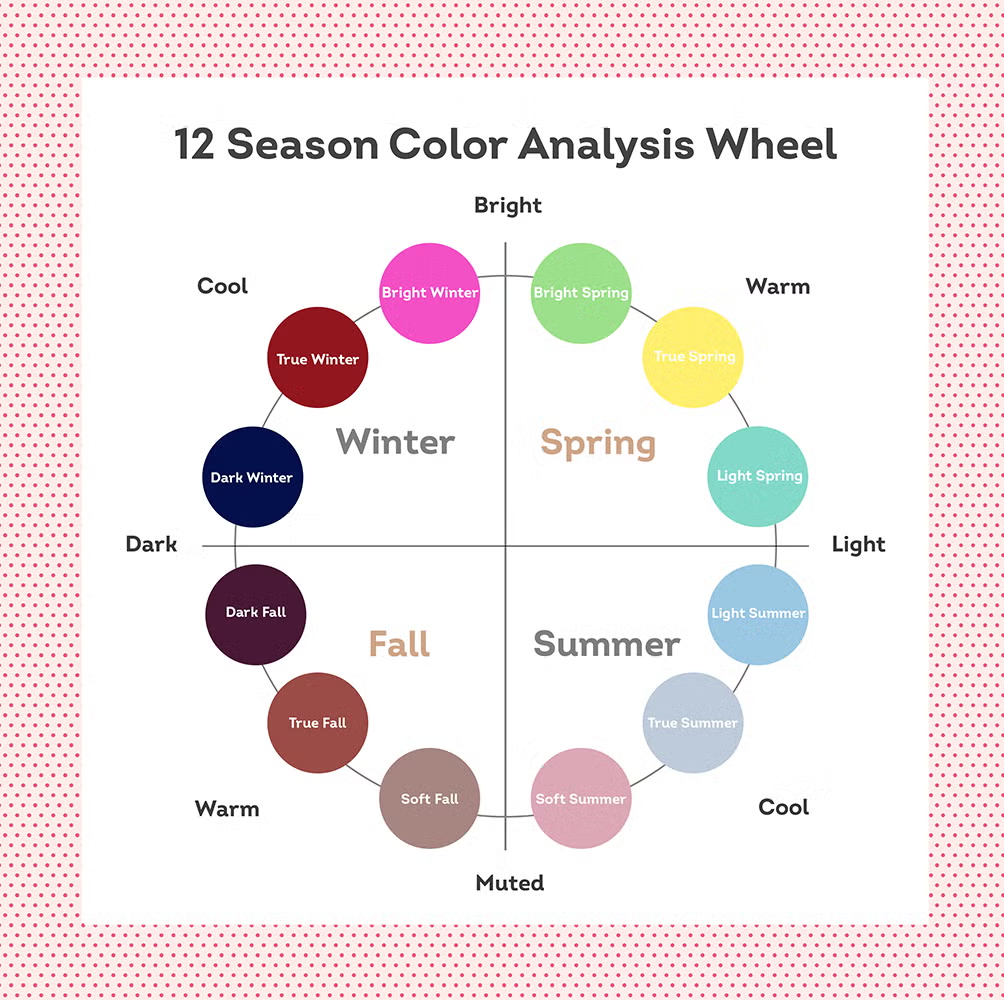 Jackson introduced a four season system where people with yellow and therefore warm undertones were either spring or autumn; those who had a cool base were either winter or summer. Additionally, if someone’s hair was lighter than medium brown, which meant that it was more of a tint than a hue, they were a spring or a summer. Dark hair was indicative of either winter or autumn.
However, although Jackson got the first two aspects of the color seasons right, she was missing a crucial third step. Most people do not fit evenly into Jackson’s categories because it did not account for chroma, the dimension that accounts for fluidity between the four seasons by acknowledging color overlap. Colors that are bright and clear have a high chroma, while colors that are muted and soft have a low chroma.
When all three dimensions are considered, they form a beautiful arrangement of colors into not four, but twelve sub seasons, each with its own set of colors. These different palettes are Dark Winter, True Winter, Bright Winter, Bright Spring, True Spring, Light Spring, Light Summer, True Summer, Soft Summer, Soft Autumn, True Autumn, and Dark Autumn. Out of the three main aspects of color, each sub season features two main qualities.
Dark Winter is characterized by dark hues and cool temperatures. True Winter emphasizes colors that are cool and bright. And Bright Winter focuses on high chroma colors that are also cool. Bright Winter is the bridge between Winter and Spring, and Dark Winter is a combination of Winter and Autumn. For each of these sub categories, the characteristic that comes first is the more important of the two.
The other seasons follow a similar pattern. Bright Spring is bright and warm, True Spring is warm and bright, and Light Spring is light and warm. Moreover, Light Summer is light and cool, True Summer is cool and muted, and Soft Summer is muted and cool. Lastly, Soft Autumn is muted and warm, True Autumn is warm and muted, and Dark Autumn is dark and warm. Each season shares a quality with the ones that it borders, and this allows for flow between seasons.
Interestingly, in nature, the seasons work in a very similar fashion. They flow into each other, and as they do, the world changes color.
Whether you choose to determine your colors is entirely up to you; however, color can hold a lot of power. It can seem restrictive to have to dress to a specific set of colors, but I have found inspiration in knowing that nature designed a color palette for each one of us. Color is not just around us, it is also within us, and I encourage you to let your inner colors glow.


